Context
A fault code is a starting point. Diagnosis may require combining symptoms, measurements, service history and vehicle-specific technical documentation.
From a code to a technical question
A fault code identifies a condition observed by a system; it does not by itself prove that a part needs replacement. An assistant could relate it to the vehicle, reported symptoms and available documentation. Its value would depend on the quality of those connections and the ability to verify each reference.
Design scenario: preparing a workshop record
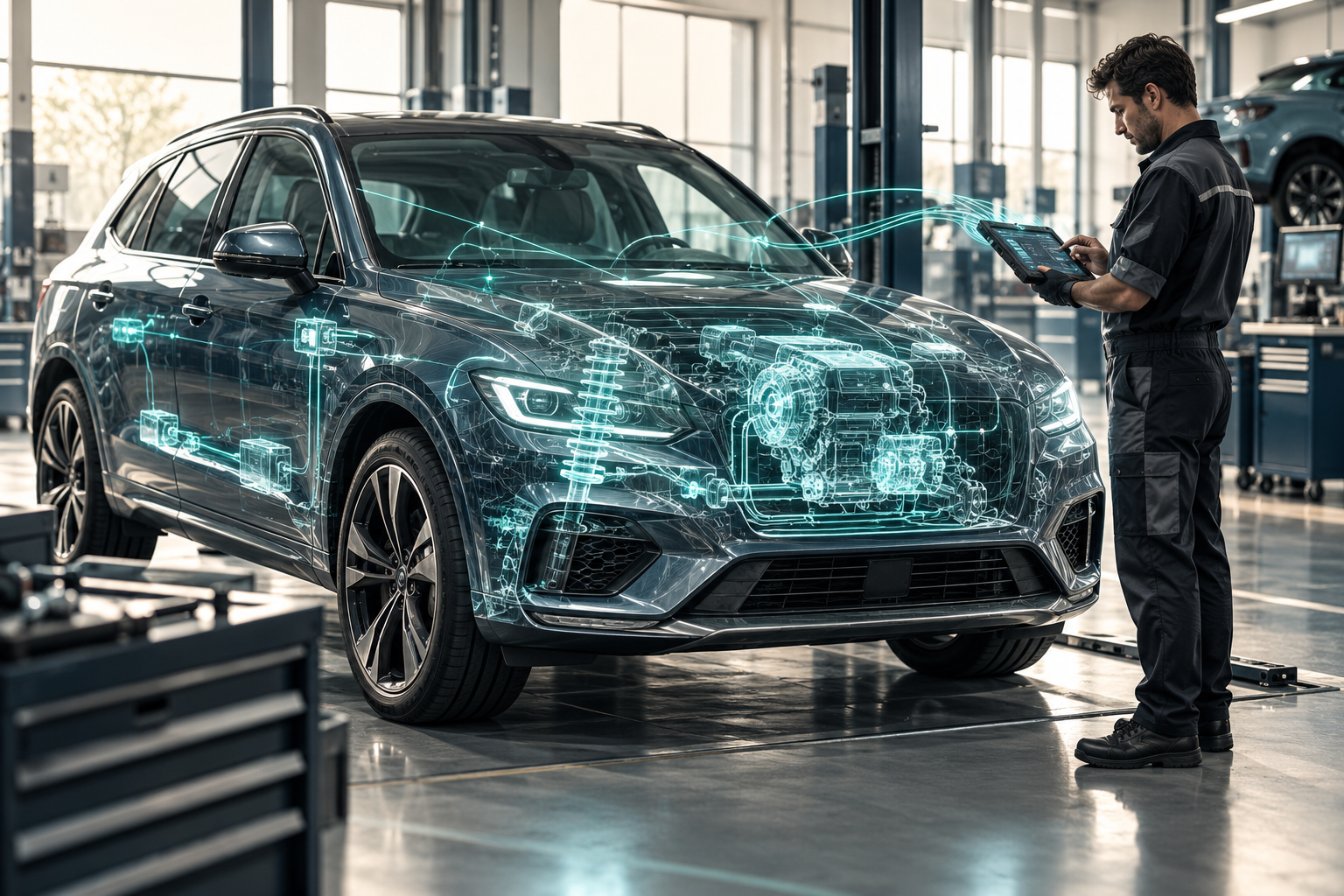
Fictional workshop example involving a connected fleet vehicle: the fleet manager has received several fault reports before the visit. A future assistant could organise codes, chronology, available measurements, model and previous work in a shared investigation record. Sources and missing data would remain visible. The technician would investigate; the record would not trigger automatic part replacement.
Vehicle and service history
Measurements and technical documents
Confirm before intervention
Conceptual workflow: it illustrates the scenario, not an existing tool.
Make coverage explicit
Make, model, powertrain, software version and documentation access rights all influence the scope. A multi-brand offering should disclose its limitations before analysis. An unsupported vehicle should produce a clear refusal rather than a generic answer presented as a vehicle-specific diagnosis.
Workshop and fleet workflows
A workshop needs context for an individual case. A fleet platform could aggregate events and help competent teams organise investigations. Remote diagnostics would require suitable collection hardware and access. No connector, onboard reading or fleet service is provided here.
Frequently asked questions
Does a fault code identify a replacement part? Not by itself. Does this concept support every vehicle? No actual coverage is claimed. Can a diagnostic scanner be connected to this site? No: this is a design brief illustrating a future product.
A sector reference
Checked on 30 October 2026: Bosch presents commercial cloud and predictive diagnostics for fleets using vehicle diagnostic data. Connected diagnostics is therefore an existing commercial use. Our assistant and interface remain concepts; the Bosch page establishes neither a universal conversational assistant nor multi-brand coverage of our project.
Where could aidiagnostic.ai fit?
For an automotive aftermarket business, aidiagnostic.ai could be the primary address for an assistant serving workshops and fleets. An automotive descriptor identifies the field while the domain remains common to workshop, fleet and remote diagnostic variants. The strategic proposition is a product identity independent of a vehicle brand with consistent international wording. Data access and technical coverage still need to be built; the domain does not provide them.
Before building a future product
Data and documentation access, model coverage and safety procedures must be defined. A fault code alone does not establish the cause of a failure.